
The Michelson Morley experiment (MMX) was formally named the most failed experiment of all time as it didn’t detect earths “supposed” motion around the sun. The paper entitled: “On The Relative Motion of the Earth and the luminiferous ether” perplexed physicists at the time as it suggested earth was stationary.
MMX is continually misrepresented and convoluted by lower-tier educators and Youtube personalities because what the results suggest. And so, we explore what the higher-tier physicists at the time actually say, how this is misrepresented by the lower-tier educators and the extent to which Einstein went to solve this problem. More importantly, we discuss how the solution continues to be pivotal in shaping our modern understanding of relativity, and how these solutions lack empirical validation and evidence from experimentation.
We look more specifically of what the MMX meant to Einstein. This important to look at his view above anyone else as he formulated the modern interpretation of gravity today. Rest assured, all key points are are directly referenced and quoted from the original source. Each claim will be referenced so you can look those up for yourself.
1. MMX Experiment, & Its Results?
The MMX, conducted in 1887 by American physicists Albert A. Michelson and Edward W. Morley, aimed to detect the Earth’s motion around the sun, whilst also establishing intrinsic properties of the luminiferous ether (aether). The aether is merely a medium through which light propagates, much like how the sea utilizes water to carry waves. This notion will be explored in greater detail in section 5.
What is the MMX?
The experiment involved splitting a beam of light into two perpendicular paths, then recombining them to detect any interference caused by the Earth’s motion around the sun. By splitting the light beam would ensure the light was in-phase as it left the light source. This was a remarkable way to ensure accuracy.
Below, is a video where WitsitGetsIt explains what the experiment is and provides an insightful breakdown of Albert Einstein’s perspective, offering a thorough analysis. You can also find the book here: Albert Einstein: Relativity the Special and General Theory. 1920. p63-69
Witsit Breaks Down Einstein’s Book
Go to Time: 35:40 (in the above video) where Witsit breakdown the book.
MMX Interferometer Depiction
This is just a basic depiction of how the MMX experiment operated.
The idea is very simple. If you shine a light on an object moving away from you, the light has to travel a longer distance than if that object was moving towards you (this is similar to how police speed radar guns work detect car speeds). Therefore, if we project a beam of light in a direction opposite to the motion (Earth moving away from the reflector) and another beam perpendicular to the direction of motion (Earth moving with the reflector), it implies that the light traveling against the direction of motion would cover a longer distance. Thus, MMX would read an interference in the returning light.
MMX Prediction Vs. Actual Results
Based on our understanding of light propagation and 500 years of experiments leading up to MMX, physicists could accurately predict the expected interference pattern, detected by interferometry. These are also known as phase shifts, or phase displacement. The amount of interference can be translated into speed using the formulation outlined on page.342 in the official paper. Each fringe represents approximately 6km/sec in speed.
- The predicted reading: 5 fringes indicating 30km/sec (universally accepted speed of earth)
- The actual reading: Just over 1 fringe showing 6km/sec (which they called a NULL result)
They utilized a calculation to emphasize that the predicted interference should amount to 0.05, as indicated in the below image. This corresponds to 5 fringes, reflecting the universally accepted 30KM/sec velocity of Earth as it orbits the sun. However, you can see the actual interference pattern, is just over 1 fringe. Each fringe represents 6km/sec.
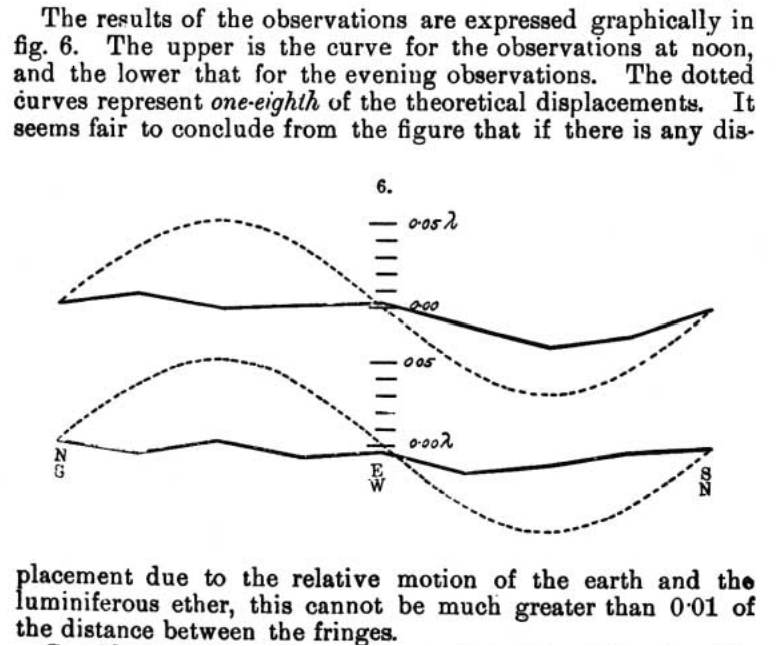
How to read the graph:
- The dotted line: represents the predicted 30km/sec being 5 fringes
- The solid line: represents the actual 6km/sec being just over 1 fringe
As you can see the actual result was 1/6th – 1/8th of the predicted value which they called a NULL result. Even though it wasn’t a true null result it would have to be a NULL result if they was able to conjure a viable solution (we discuss this in section 5).
In summary, when they went to detect earths motion around the sun they didn’t get the predicted 5 fringes needed. It is important to note that MMX detected over 1 fringe of interference which is 1/6 – 1/8 of the predicted value giving an actual result of 6km/sec.
Was MMX capable of detecting the motion of the earth?
Given the extreme precision of the device, the motion of the Earth should be readily detectable by the interferometer (as discussed below). Both of these renowned physicists agree that the experiment’s sensitivity had a high enough resolution. In section 2, we delve into Einstein’s detailed perspective on the experiment.
“Although the estimated difference between these two times is exceedingly small, Michelson and Morley performed an experiment involving interference in which this difference should have been clearly detectable.”
Albert Einstein: Relativity the Special and General Theory. 1920. p68.
“This was an experiment that was ten times more sensitive than it needed to be. It could have detected speeds as low as two miles a second instead of the known 2mps that the earth as in its orbital motion around the sun. It didn’t detect it. What’s the conclusion from the Michelson-Morley experiment? The implications is that the earth is not moving”
Physicist, Richard Wolfson
This means that if we’re measuring fringes at a predicted 0.05 (as discussed above) then a resolution that is ten times more precise would be 0.005. For purposes of clarity, we are effectively measuring centimeters on a millimeter ruler.
In addition, given the inherent challenge of achieving precisely equal arm lengths for the two paths, Michelson devised a solution. He opted to rotate the apparatus by 90 degrees, ensuring that each arm, in turn, aligned with the direction of the Earth’s motion. This adjustment enabled him to compensate for any discrepancies between the arm lengths and accurately assess the effects of the Earth’s motion on the measurements.
2. How Higher-Tier Physicists Interpret the Results
The consensus among higher-tier physicists aligns in their shared perspective on the MMX. They collectively affirm that the MMX aimed to detect Earth’s motion as it travels around the sun; however, the experiment ultimately fell short in achieving this detection. Thus, special relativity emerged as a consequence, wherein two fundamental principles were established: length contraction and time dilation (detailed exploration in section 3).
This section holds significance because there’s a risk of confusion caused by lower-tier educators misinterpreting the MMX. Therefore, it becomes imperative to delve into the viewpoints expressed by higher-tier physicists to gain a clearer understanding of their perspective of MMX and how it linked to the theory of relativity.
Experiments that failed to detect earths motion
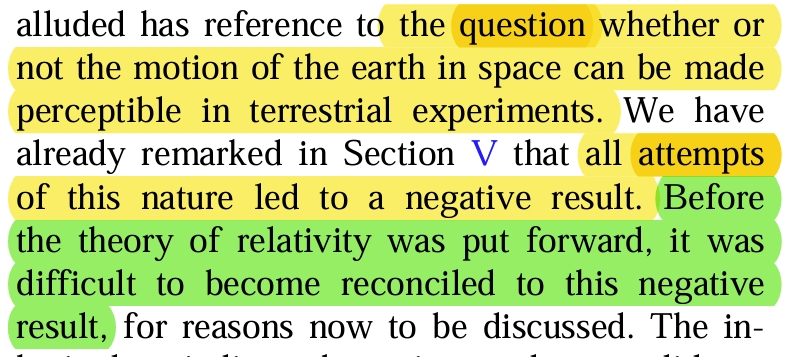
Below, we break down Einstein’s statement, examining what he meant about the failure to detect the motion of the earth, and that it links to the theory of relativity.
- Einstein explains on Page61. Line11-15 (highlighted in yellow)., “to the question whether or not the motion of the earth in space can be made perceptible in terrestrial experiments.“…”all attempts of this nature led to a negative result“.
- It’s evident in Einstein’s statement: when attempting to detect the motion of the Earth, they conducted experiments trying to detect the motion of the earth, and these experiments yielded a negative result, signifying their failure to detect it .
- On Page61. Line17-20 (highlighted in green)., not only is he saying that all attempts failed to detect the motion of the earth, but illudes that the theory of relativity was the solution: as why “it was difficult to become reconciled to this negative result“.
As evident, there is a clear connection to “the question”: whether Earth’s motion is perceptible (not, if there’s an aether). He then goes on to say of various experiments were conducted with the aim of detecting Earth’s motion around the sun, and unfortunately, these experiments yielded negative results (go to section 4 to view all experiments that were conducted). By which The theory of relativity played a crucial role in Einstein finding reconciliation with the negative result.
In the next section, Einstein provides context about a specific experiment, establishing connections to the MMX. Here, he explores the implications of the negative result and proceeds to discuss how the overarching framework of the theory of relativity served as the solution that ultimately facilitated his reconciliation with the unfavorable outcome.
MMX is the Failed experiment in question
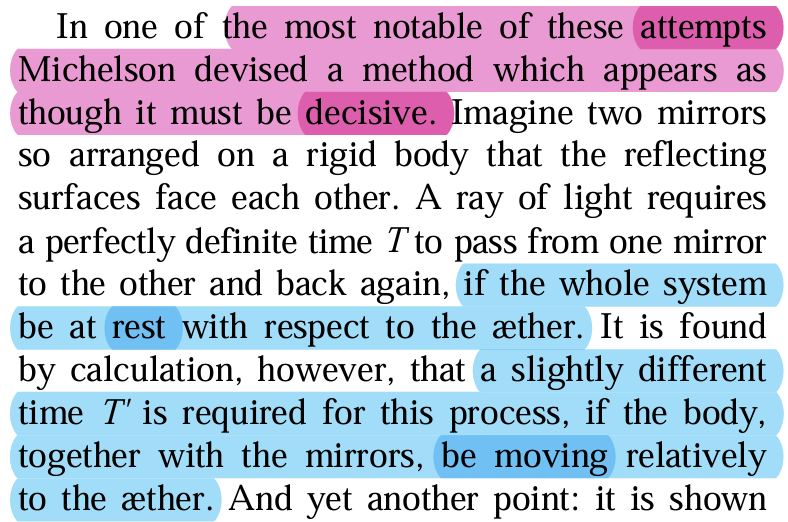
Below, we break down how MMX is the failed experiment is question.
- Einstein explains on Page62. Line16 (highlighted in pink)., “the most notable of these attempts“. As discussed in the above section: by attempts, Einstein is speaking about experiments that tested the “question whether or not the motion of the earth“…”all attempts of this nature led to a negative result” As discussed, this is referring to the experiments that did not detect the motion of the earth.
- Einstein further elaborates on Page62. Line18 (highlighted in pink)., by saying that “the most notable of these attempts“… “Michaelson devised a way that must of been decisive“. In this context, the term “decisive,” it means that not only did MMX try to detect the motion of the earth, but it had the capability to detect the motion of the Earth.
This is important as lower-tier educators are eluding to the fact that MMX did not try to detect the motion of the earth. When they finally concede to that point, they then say the MMX wasn’t sufficient enough to detect the motion. As we can see here, Einstein disagrees with both these claims.
He then goes to explain the intricacies of the experiment and what should of happened.
- Einstein then explains on Page62. Line23-28 (highlighted in blue)., “if the whole system be at rest with respect to the Aether“… “a slightly different time T’ is required for this process, if the body, together with the mirrors, be moving relatively to the æther.” Here, he suggests that during the MMX, the light’s return time would vary slightly if both the Earth (“the body“) and the mirrors (representing the MMX) are in motion. Then, if the entire system, meaning both the Earth and the mirrors, is at “rest” (not moving). In straightforward terms, if the Earth is in motion relative to the aether, one light beam will take more time to reach the receiver than the other. Moreover, Einstein later describes this delay in the light’s return time, accounting for Earth’s motion, as an interference…
In summary, on page 61, lines 11-15 (highlighted in yellow), Einstein discusses the MMX experiment, emphasizing its focus on detecting the Earth’s motion around the sun. He uses the term “attempts” to highlight the experiment’s inability to detect this motion, emphasizing that all efforts resulted in a negative outcome. Essentially, the MMX experiment failed to detect Earth’s motion around the sun. Not only that but he then goes on to say the experiment should of been decisive—Meaning, it should of detected the motion.
This may seem evident, yet it’s a crucial point that warrants attention, especially given instances where lower-tier educators erroneously claim that the experiment had no relevance to detecting Earth’s movement, and that the experiment wasn’t capable of detecting earths motion. It’s apparent that such assertions are inaccurate, and a careful examination confirms the experiment’s clear connection to the detection of Earth’s motion.
MMX Should of detected earths motion
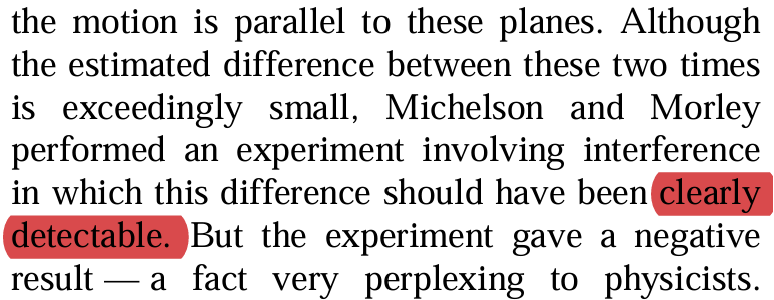
Below, we outline how MMX should of detected earth motion with or without the aether.
- On Page 63, lines 6-8, Einstein clarifies that the “interference” should have been “clearly detectable.” In this context, he explicitly outlines the connection between the interference, its relevance to the negative result (detecting Earth’s movement), and asserts that it should have been clearly detectable.
Einstein speaks about the fundamental “question” (as explained on page61), being the motion of the earth. In addition, not only does he clearly state that the experiment was to measure earths motion around the sun – but, later says (on Page63.Line5-8) that Michaelson Morley should of detected it.
Earths motion should of been detected with or without the aether
Following the discussion about MMX’s capability to detect Earth’s motion, Einstein introduces the concept of the aether into the experiment. It’s crucial to recognize that the concept of aether was a theoretical construct posited as a medium through which light could propagate, similar to how ocean waves require water. At that time, two hypotheses regarding the aether were proposed (stationary or fixed aether): however, experiments leading up to MMX, suggested they were to detect an additional interference from a slight aether drift.
- Firstly, there is no mention of aether when Einstein speaks about the fundamental “question” (as explained on page61), as the experiment was primarily aimed to measure the motion of the earth.
- Secondly, in context of the aether: if there were an aether, the experiment should have detected the motion of the Earth (at the predicted 30 km/sec). Any interference caused by the aether would have been expected to align similar with earths motion, with a second a second point of interference observed.
- Alternatively, if there isn’t an aether, meaning no medium through which light needs to propagate, and given the understanding of isotropic speed of light, a lack of medium means no additional cause of interference. Suggesting that any observed interference should directly relate to Earth’s motion. Hence, the experiment should have more precisely captured Earth’s motion interference, aligning even closer to the predicted 30 km/sec.
- Based on this fact, just throwing the aether out did not explain the the missing 30km/sec interference and so they was forced to introduce two concepts being length contraction and time dilation (we discuss these concepts in the next section).
In summary, the aether was perceived as an additional factor of interference, alongside Earth’s motion. It’s worth noting that with the presence of an aether, there are two potential points of interference, whereas without it, there’s only one. Given the hypothetical nature of the aether during that time, uncertainty persisted regarding whether it was fixed or drifting, complicating its integration into the experimental equation.
Therefore, the predicted 30 km/sec value, in the absence of the aether, presents a greater challenge for the heliocentric model. This is because without the aether, there is only one point of interference, suggesting that MMX should have more accurately detected the 30 km/sec movement of Earth, due to the reduced complexity of having only one point of interference. Essentially, Earth’s motion should have been detectable, aether or no aether.
3. What Was The Solution To The Problem?
As outlined in section 2, higher-tier physicists unanimously acknowledge the issue presented by the MMX, which yielded a NULL result. The challenge arose from the reluctance to accept the implication that the Earth was stationary. Consequently, scientists embarked on a quest to find solutions, resorting to mathematical formulations. They took the primary measurements (upto second order) from the MMX, which failed to detect Earth’s motion around the sun, and began introducing arbitrary secondary corrections—essentially manipulating the true measurements—to account for the apparent absence of Earth’s orbital motion detection.
They accomplished this by manipulating the only two variables available to them and employed these as placeholders in their formulations. These variables pertained to the length of the moving object and the time it takes for the object to travel. It is important to note there was a third potential variable being the constancy of light. However, this variable had to remain constant, adhering to Einstein’s formulation that light maintains a constant speed in all inertial reference frames and coordinate systems (we discuss this later in the chapter). In essence, regardless of where the light is observed, its speed remains the same. This constancy of light speed is crucial as it serves as the reference point to which object in motion can be measured against. In summary, the reliability of light as a reference point hinges on its unchanging nature.
Overall, Einstein’s secondary corrections (formulated from the results of MMX) are speculative and without evidence. We will go in detail below…
Length Contraction
The solution put forward was proposed by Lorentz-Fitzgerald. Whereby, he formulated a way to explain why light beams returned at the same time, given the reification that earth was moving. His solution (without evidence) was that the aether (the background medium that propagates light) physically contracts objects in the direction of motion. Lorentz successfully formulated the math’s. Whereby, Einstein comments by saying: Lorentz solution “was the right one” for special relativity. Einstein took Lorentz formulations and engrained it into his special relativity.
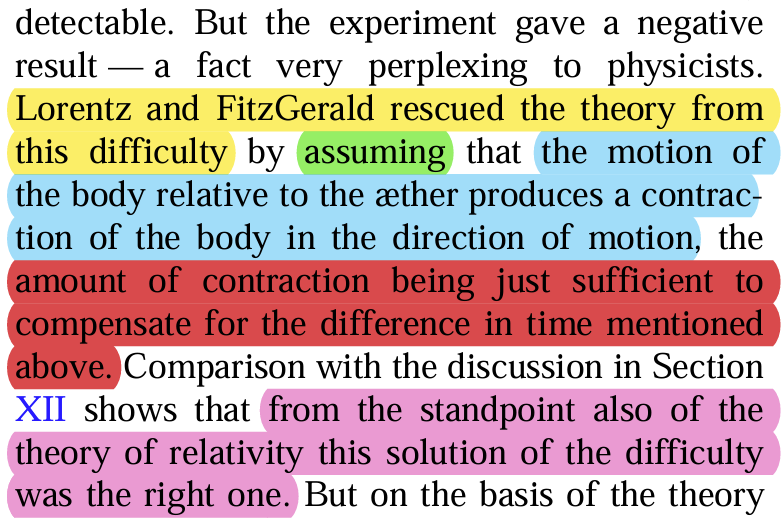
Below, we break down Einstein’s statement, examining the definition of length contraction and delving into how Lorentz-Fitzgerald originally proposed this concept.
- “Lorentz and FitzGerald rescued the theory from this difficulty” (highlighted in yellow): What difficulty precisely? The challenge is outlined above as the “experiment gave a negative results” As discussed in section 2, this negative result indicated a failure to detect Earth’s motion and Lorentz-FitzGerald came with the solution. Thus, rescuing the theory.
- By assuming (as highlighted in green) that the body (representing Earth) relative to the aether experiences a contraction in the direction of motion (highlighted in blue), he proposed a solution suggesting that Earth contracts in the direction of its motion. Importantly, this proposal was “assumed“—therefore, without evidence.
- Einstein then goes on to say that the “amount of contraction being just sufficient enough to compensate for the difference in time mentioned” (highlighted in red): What difference in time is being referred to here? The difference, where he explicitly mentions the disparity in time between the light beams hitting the receiver. So, he asserts that this contraction compensates for the missing interference. More clearly, he is saying that earth contracts in the direction of motion just the right amount we didn’t see an interference in the light beams.
- This solution was initially proposed by Lorentz-FitzGerald (as mentioned in the first bullet point). Einstein now adds context (highlighted in pink) by stating that, from the standpoint of relativity, their solution was the correct one.
In summary, Einstein suggests that not only does the Earths length contract in the direction of its motion as it travels around the sun, but it also contracts precisely enough to prevent any interference in the light beams from being observed. Consequently, this contraction cannot be detected by the interferometer as the measuring device contracts with the earth. There is no evidence to support the notion that objects contract in their direction of motion. Furthermore, no explanation was provided for the mechanism behind such contraction in moving objects, nor for why this contraction is only observed in the direction of motion. Additionally, it remains unexplained why objects contract only in their length along the direction of motion.
Nevertheless, Einstein advanced the notion of Lorentz-FitzGerald Length contraction when he introduced special relativity. In the next section, we delve into how Einstein applies this theory of length contraction to special relativity. But, more importantly we can now gather that relativity is hinged on a pivotal concept that has never been proven. Furthermore, that Length contraction is such that interferometry, a method to detect such changes, yields a null result since the contraction occurs precisely enough to cancel out observable effects.
Reference Frames & Co-ordinate systems
Above, we established that a body, such as the Earth, contracts in the direction of motion, and that Lorentz and Fitzgerald proposed “the right solution” for this phenomenon. Next, we explore how Einstein integrated the Lorentz-FitzGerald length contraction into the framework of relativity, being: the physical alteration of an object’s length is dependent on the observer’s vantage point.
Before delving into how length contraction is applied to special relativity, it’s crucial to grasp the concepts of reference frames and coordinate systems.
Reference Frames
In the context of relativity, there are primarily two kinds of reference frames: inertial reference frames and non-inertial reference frames.
- Inertial Reference Frames: Inertial reference frames are frames of reference in which an object either remains at rest or moves at a constant velocity (which includes moving with a constant speed in a straight line). According to the principles of both special and general relativity, the laws of physics appear the same in all inertial reference frames. This is often referred to as the principle of relativity.
- Non-Inertial Reference Frames: Non-inertial reference frames are frames that are accelerating or rotating. In these frames, additional forces, such as fictitious forces (like centrifugal force in a rotating frame), may appear. While the laws of physics are still consistent in these frames, they may be more complicated to describe due to the appearance of these additional forces.
Special relativity, is primarily concerned with inertial reference frames and the behavior of objects moving at constant velocities. Einstein is not so much interested in None-inertial reference frames as accelerating speeds are detectable.
Coordinate systems
In the context of relativity, there are primarily two kinds of co-ordinate systems: Lab frames and None-lab frames.
- A lab frame (laboratory frame) refers to a specific inertial frame of reference. More specifically, assuming the Earth is an inertial frame of reference, it would be a location fixed to the Earth, excluding entities like boats, cars, or planes that may introduce non-inertial effects.
- A coordinate system is attached to the laboratory, and it is often considered an inertial frame as long as the laboratory is not undergoing significant acceleration or rotation. Lab frames are practical choices for experimental work as they simplify measurements and calculations.
- A non-lab frame is a coordinate system undergoing acceleration or non-uniform motion distinct from the laboratory frame or the chosen point of reference.
When delving into the MMX, the discussion takes place within a lab frame, wherein the coordinate system is fixed on the Earth. Einstein used reference frames and co-ordinate systems to gel length contraction into special special relativity (we discuss how in the below section…).
Length Contraction & Special Relativity
In Einstein’s writings, immediately following his explanation of Lorentz-FitzGerald length contraction—where he delves into how bodies contract in the direction of motion—we explored the concept of inertial reference frames and co-ordinate systems to provide context.
This context sheds light on how Einstein incorporates length contraction into the framework of special relativity. He clarifies that observers at different locations will perceive varying lengths. More specifically, in the context of an “observer moving with the Earth“, also known as the lab frame, no contraction is observed. Einstein further explains this is what was observed in the MMX, where the “mirror system” does not appear to be shortened—as it contracted along with the Earth. Consequently, providing clarification for the MMX’s NULL result.
Additionally, he then explains when an observer might perceive the Earth’s length to be “shortened for a coordinate system that is at rest relative to the sun“. More specifically, Einstein suggests that if an observer is in a coordinate system at rest relative to the sun (implying the observer is moving at the same speed as the sun, hence being in a non-laboratory frame away from the solar system), then the Earth, which is in motion relative to this observer, would seem contracted in its length. Simply, the relativistic effect of length contraction, where an object in motion, when observed from a relatively stationary frame, appears shorter in the direction of its motion.
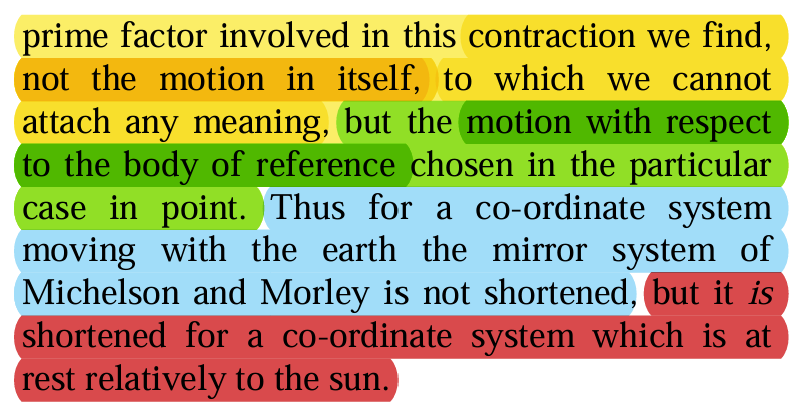
Below, we dissect Einstein’s statement, exploring the observational points (coordinate systems) and the relativistic effects of length contraction.
- The “prime factor” (highlighted in yellow) is the the relative motion between the observer and the object being observed. It suggests that the contraction of lengths is a consequence of the observer’s perspective, rather than an inherent property of the object’s motion.
- In this context, the phrase “the prime factor involved in this contraction we find, not the motion in itself” underscores that the primary factor influencing length contraction is not the motion per se, but rather how the motion is perceived from a particular coordinate system. The emphasis is on the observer’s perspective. If the motion itself were the decisive factor, we would have detected the expected 30 km/second fringe in the MMX. However, this would imply measuring an absolute variable, which contradicts the principles of relativity. Therefore, the only way to discern motion is by examining the relative motion between moving bodies.
- Thus, suggesting that, in isolation, motion lacks inherent meaning. And he states where it does become significant (highlighted in green): when considered in relation to a specific “body of reference“.
- Consequently saying, there’s no absolute or universally “correct” measurement of length. Instead, how long something appears depends on the observer’s coordinate system.
Einstein’s then gives a direct example of what he means:
- “For a coordinate system moving with the Earth“: If you are in a coordinate system that is moving along with the Earth, the mirror system of the MMX does not appear shortened. In this frame, the lengths of objects on Earth, including the mirrors, would not appear contracted as the measuring device is contracted with the earth and so no interference will be detected by the interferometer.
- “But it is shortened for a coordinate system at rest relative to the sun“: If you are in a coordinate system that is at rest relative to the sun, observing Earth from that frame, the mirror system (and other objects on Earth) would appear contracted. Meaning, if you’re in a coordinate system outside the solar system, due to the relativistic effect of length contraction, a interference will be detected by the interferometer.
In summary, from the perspective of an observer from the sun (or an observer in a different coordinate system than earth), the Earth would appear contracted, but when viewed from Earth itself, it would not appear contracted.
For example, if there’s a rod at rest in a lab frame (on earth), and an observer is moving relative to the lab frame (not on earth), the observer would measure the length of the rod to be contracted along the direction of motion due to length contraction.
Time Dilation
Based on the findings of the Michelson-Morley experiment (MMX) and its null result, we concluded that length contraction in the direction of motion could explain the absence of significant differences in the speed of light along different directions. If objects contract in the direction they’re moving, it follows that the time it takes for them to travel would also be affected. Consequently, time has to slow down to account for the missing time difference, ensuring consistency with the observed results of the MMX.
What is Time Dilation
Time dilation is a phenomenon predicted by Albert Einstein’s theory of special relativity. It occurs when an observer in one inertial reference frame perceives time passing at a different rate for an observer in a different inertial reference frame that is in relative motion. Essentially, time dilation implies that time can appear to move slower for an observer in motion compared to one at rest, and it becomes more pronounced as the relative velocity between the two frames approaches the speed of light.
Experiments attempting to prove time dilation
- LIGO: Ligo, the Laser Interferometer Gravitational-Wave Observatory, is a scientific experiment with facilities in the United States designed to detect gravitational waves—ripples in the fabric of spacetime. It consists of two detectors located in Washington and Louisiana, which use laser interferometry to measure tiny changes in distance caused by passing gravitational waves. LIGO’s detections have provided groundbreaking insights into astrophysics and our understanding of the universe.
- Global Positioning System (GPS): The clocks on satellites in the GPS system experience time dilation due to their motion relative to observers on Earth. Corrections for both special and general relativity are essential for accurate GPS measurements.
- Particle Accelerators: High-energy particles in accelerators can approach speeds where relativistic effects become significant. Experiments in particle physics have consistently confirmed predictions of time dilation.
- Muon Decay Experiment: Muons are subatomic particles that decay over a very short time. However, muons created in the upper atmosphere as a result of cosmic ray interactions can reach the Earth’s surface due to their high velocity. According to Earth-bound observers, these muons should decay quickly, but they are observed to last much longer in experiments. This can be explained by time dilation.
LIGO
Global Positioning System (GPS)
Particle Accelerators
Muon Decay Experiment
Conclusion
Because of the MMX a challenge arose from the reluctance to accept the NULL result provided by MMX implication that the Earth was stationary. They began introducing arbitrary secondary corrections in the form of length contraction and time dilation This was not grounded by any sort of evidence. They state that objects length is apparent and can change dependent on a persons vantage point.
Based on the fact that the 30km/sec should of been observed with or without the aether they was forced to interduce two new concepts being length contraction and time dilation. This is because by just throwing the aether out did not explain the the missing 30km/sec interference and so length contraction and time dilation was used to compensate for the missing interference.
In addition, Because of this Einstein was also forced to throw the idea of the aether out along with Newtonian mechanics, and changed all physics. This is because the Newtonian mechanics and the aether was seen as an absolute point of reference. According to this idea, Newtonian and aether would provide a fixed and universal frame against which the motion of celestial bodies, including the Earth, are measured.
4. What’s the Problem to the Solution
In this section, we go over the issues relativity was faced with since the introduction of relativity and MMX experiment.
Problem 1: All Evidence Is Antithetical to the Theory
The first problem to the solution is outlined in the previous section: both length contraction and time dilation are theoretical concepts not backed by any sort of evidence and purely hypothetical. Furthermore, the limited evidence in the mainstream scientific community supporting relativity is lacking integrity, and empirical measurements, not exclusive to heliocentrism and has alternative explanations that are more overwhelmingly viable.
Furthermore, not only was there no evidence found supporting length contraction and time dilation, but all experiments conducted prior to the MMX also failed to detect Earth’s motion. These experiments also contributed significantly to our understanding of how to accurately measure light.
Problem 2: We can measure objects going in a curved path
Another significant issue emerged a few years later with the development of the Michelson-Gale-Pearson experiment (MGPX). This experiment introduced further complications regarding why motion should have been detected in the MMX.
What is the MGPX?
The MGPX, conducted in 1925, is a modified version of the MMX. The interferometer was rotated to test for any variations in the speed of light in different directions due to the Earth’s rotation. It involves changes in interference patterns when light is split and then recombined after traveling along different paths in a rotating system.
The Michelson–Gale–Pearson experiment (MGPX) successfully detected the Sagnac effect and with a 98% accuracy. This posed another problem because, as outlined in the Michelson–Morley experiment (MMX), experiments of this kind using light were expected not to detect motion. According to the length contraction concept, the effect should not have been observable.
The Sagnac Effect
The Sagnac effect is a phenomenon related to the interference of light in a rotating system. It was first observed by French physicist Georges Sagnac in 1913. The effect occurs when a beam of light is split into two beams that travel in opposite directions along a closed path and are then recombined. If the system is rotating, the travel times for the two beams become unequal, resulting in a phase difference when they are recombined.
In the context of experiments testing the isotropy of the speed of light, such as the Michelson–Gale–Pearson experiment, the Sagnac effect becomes relevant when the apparatus is rotating, allowing scientists to observe and measure the influence of Earth’s sidereal rotation on the interference patterns of light.
Sidereal Rotation
In the context of physics sidereal rotation can equate to a rotating earth again fixed sky, as presented in the mainstream heliocentric model, but also, a fixed earth against a rotating sky as presented in the geocentric model.
Our earthly observations align with a seemingly stationary Earth (as we don’t feel the Earth’s motion) and a rotating celestial sphere, where we perceive the stars, sun, and moon moving across the sky. In isolation, these observations align precisely with a geocentric model. In addition, experiments such as Airy’s Failure detected a moving sky against a station earth.
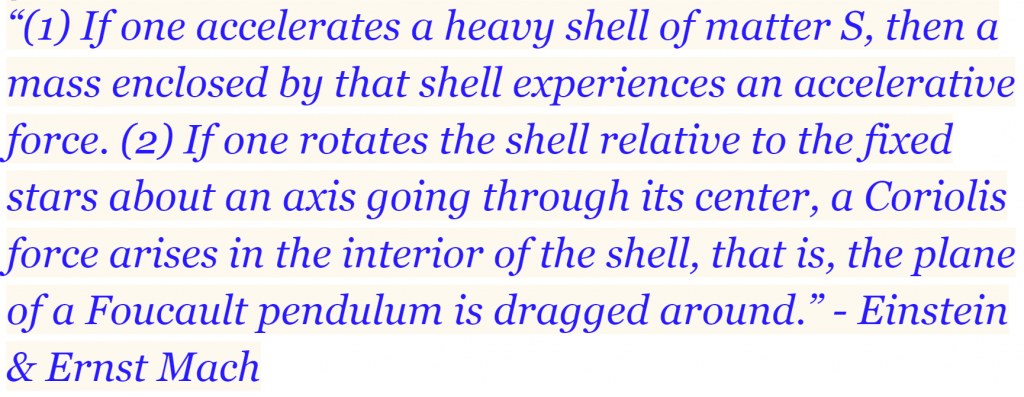
As evident in the quote above from a letter written by Einstein to Ernst Mach, if the Earth were stationary and a massive shell above (comprising the sun, moon, and stars) were to move, the transfer of motion would induce Coriolis and centrifugal effects.
Coincidently, the observations directly accessible to us can be precisely measured with extremely sensitive equipment. In addition, these effects are measured and accepted by the scientific community without the assumed aether. Contrarily, heliocentric claims, such as the Earth’s orbit, aren’t directly observable nor detectable by even the most sensitive instruments. This discrepancy leads to a plausible conclusion that the reason these effects aren’t detected is simply because they do not occur.
Problem 3: We can measure objects going in a linear path
To their astonishment, the Sagnac observation persisted. This placed the scientific community in yet another perplexing situation. Desperately seeking an explanation, they proposed a revised idea: despite the Earth’s motion along an circular path, the influence of spacetime causes it to follow a linear trajectory. They called this geodesic: the apparent circular motion is then attributed to the object freefalling, through bending and warping of spacetime.
Again, there was no evidence for this—to that effect it didn’t make much sense. By saying it was free falling in a circular path through the gravity well of spacetime. However, the persisted with the idea and named the phenomenon that earth travels in a geodesic path.
Geodesic Path
In more simpler terms, MMX didn’t detect the earth motion around the sun because it is geodesic and travelling in a liner manner. Whilst MGPX was able to detect earth sidereal rotation because its moving in a circular manner.
Later experiments, specifically: Wang 2004, showed we can actually detect motion in a linear path.
In summary, upto this point rotation, was a word used to explain earth motion around the sun-After discovering the Sagnac effect Einstein change the definition, pertaining sole to the sidereal rotation (being the spin of the earth). Yet, another problem. However, to the desperation of this explanation it was yet again debunked bunked by wang,2004. He created another device that can detect the Sagnac affect in a linear path. Proving Einstein’s claim wrong.
Absolute space is still a reference point for relativity
Electro magnetism is not compatible with relativity
5. Did MMX Actually debunk the Aether?
In section 3, MMX experiment didn’t yield a true NULL result as suggested. Instead, it detected one fringe of interference, which remained unexplained. At that time, scientists required explanations for length contraction and time dilation. Therefore, they treated this result as zero to facilitate a mathematical solution.
The researchers attributed the NULL result to instrumental error, despite the instrument being ten times more sensitive than necessary. However, this explanation posed issues during the Dayton Miller experiments, where the interference pattern persisted and exhibited correlations with specific times of the year, solar eclipses, and elevation.
Special relativity & aether
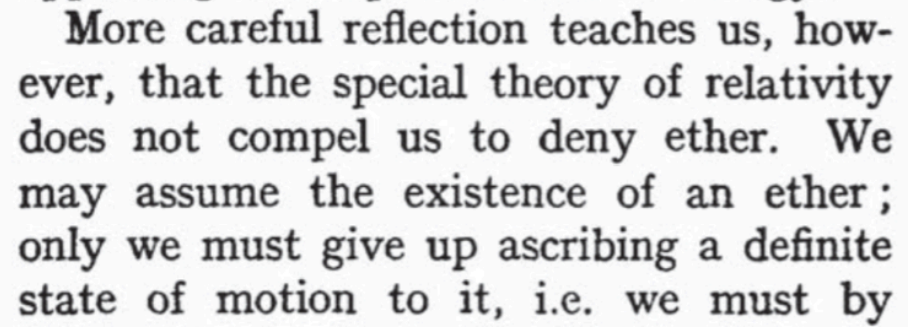
Einstein concedes, later acknowledges an aether, explaining how special relativity aligns with it without being an absolute reference.
The was massive repercussions for throwing the aether out because there was 700 years on the study on of light that reinforced the idea that light had to propagate through a medium such the oceans waves propagate through water.
The study of light:
- Roger Bacon (1214-1292): Split a light beam into a color spectrum, laying early groundwork for the study of optics.
- Isaac Newton (1666): Demonstrated the dispersion of white light into a color spectrum using a prism, advancing our understanding of light and color.
- Joseph von Fraunhofer (1826): Split light and measured the wavelength of each color, contributing to the development of spectroscopy.
- François Arago (1800): Demonstrated that light behaves like a wave and attempted to measure Earth’s movement using a telescope, yielding a null result.
- Fizeau (1849): Conducted experiments measuring the speed of light, providing important insights into the nature of light and its propagation.
- Fresnel Drag Experiment: Demonstrated that light exhibits interference effects both with and against the direction of water flow, contributing to our understanding of wave behavior.
- Airy’s Failure (1871): Utilized light to attempt to prove that the sky was moving rather than the Earth, but the experiment yielded null results, influencing subsequent experiments and theories.
- Michelson-Morley Experiment (1887): One of the most famous experiments in physics, aimed to detect the motion of the Earth through the hypothetical “aether,” but yielded null results, leading to the development of special relativity.
- Michelson-Gale-Pearson Experiment (1925): Explored the Earth’s rotation using interferometry and demonstrated the Sagnac effect, furthering our understanding of Earth’s motion.
- Miller Experiment: Conducted by Dayton Miller, aimed to detect an ether drift, but yielded controversial results that are still debated in the scientific community.
- Wang’s Experiment (2004): wang detected the sagnac affect using linear interferometry
To summarize, Dayton miller replicated MMX over 1 millions times and accounted for every variable. These included temperature differentials, times of year, height and more and he found there was a direct correlation between the interference and height. it seems the closer to the sky you get the phenomenon increases.
6. Lower-Tier Educator Misconceptions
MMX wasn’t about earths Orbit
The argument presented suggests that proponents of the globe model attempt to downplay the significance of the MMX (Michelson-Morley Experiment) by asserting that it was solely about the aether and not related to Earth’s orbit.
As evident in the above video Brain Cox has the same conclusion. That not only was special relativity a direct result of MMX but more importantly it failed to detect earths orbit. Not only that he uses the exact term “has no meaning” as Einstein in his 1920 book on page 64.
In addition, the title of the paper, “On The Relative Motion of the Earth and the luminiferous ether,” is highlighted as evidence to the contrary. The emphasis is placed on the word “And,” indicating that the experiment addressed both Earth’s motion (specifically its orbit around the sun) and the existence of the luminiferous ether. This suggests that there are indeed two distinct claims being investigated: Earth’s motion and the properties of the aether.
MMX debunked the aether
It debunked a stationarty aether a proved a aether wind of 5-7km/second
Firstly, as outlined in section 3, it’s evident that the MMX did not disprove the existence of the aether; rather, it was disregarded due to its implication of an absolute point of reference. Consequently, one might assume that discarding the concept of the aether would resolve the issue. However, this wasn’t the case. In addition to abandoning the aether concept, physicists also had to incorporate concepts such as length contraction and time dilation. If fixing the issue were as straightforward as simply discarding the aether, there would be no necessity for these mathematical adjustments.
Secondly, in order for the aether to negate Earth’s motion, the second point of interference caused by the aether would have to counteract Earth’s motion precisely by the same amount and in the exact opposite direction. Clearly, this notion is absurd; it’s implausible to suggest that the aether would move in perfect alignment with Earth’s motion, cancelling it out entirely.
Finally, it’s important to recognize that the study of light was well-established by the time of the MMX, with over 500 years of direct experimentation providing insights into how light behaves. Moreover, the actual readings of the MMX did detect a slight fringe shift of 6 km/sec, a finding corroborated by numerous subsequent experiments conducted by Miller and other researchers.
The 6km/sec was instrumental error
As previously mentioned, the instrumentation used in the Michelson-Morley experiment was ten times more sensitive than necessary, a factor Einstein himself deemed decisive. This sensitivity can be likened to reading centimeters on a millimeter ruler. Additionally, the detection of a fringe shift of 6 km per second corresponds with changes in altitude and times of the year, even within controlled environments. This correlation indicates that any instrumental errors wouldn’t align with specific astronomical occurrences, further strengthening the credibility of the experiment’s results.
Length contraction debunked the aether
This point is occasionally raised by educators of lesser expertise, but it’s not widely accepted. However, if length contraction were sufficient to disprove the existence of the aether, then why does it remain a fundamental aspect of the formulations in special relativity? One might argue that if length contraction alone invalidated the aether, physicists would have discarded the formulation along with the aether theory.
Length contraction was put forward to save the aether

Length contraction was the explanation for the NULL result
Final Conclusion
As discussed, in relativity Einstein used reference frames to gel these concepts together to work in a cohesive manner. To invoke the reference frame formulation Einstein was forced to throw the idea of the aether out. This is because the aether was seen as an absolute point of reference. According to this idea, the aether would provide a fixed and universal frame against which the motion of celestial bodies, including the Earth, are measured.
Additionally, it is important to note that the coexistence of a relative frame of reference with an absolute frame became untenable. As a result, Einstein had to discard the idea of an absolute reference frame. This decision meant relinquishing the longstanding foundations of science, including the abandonment of the aether theory and Newtonian mechanics. Here we witness the transformative impact of the MMX, marking a profound shift that altered the landscape of physics and ushered in an era of pseudoscience.